
Floating Temples: Isometric World
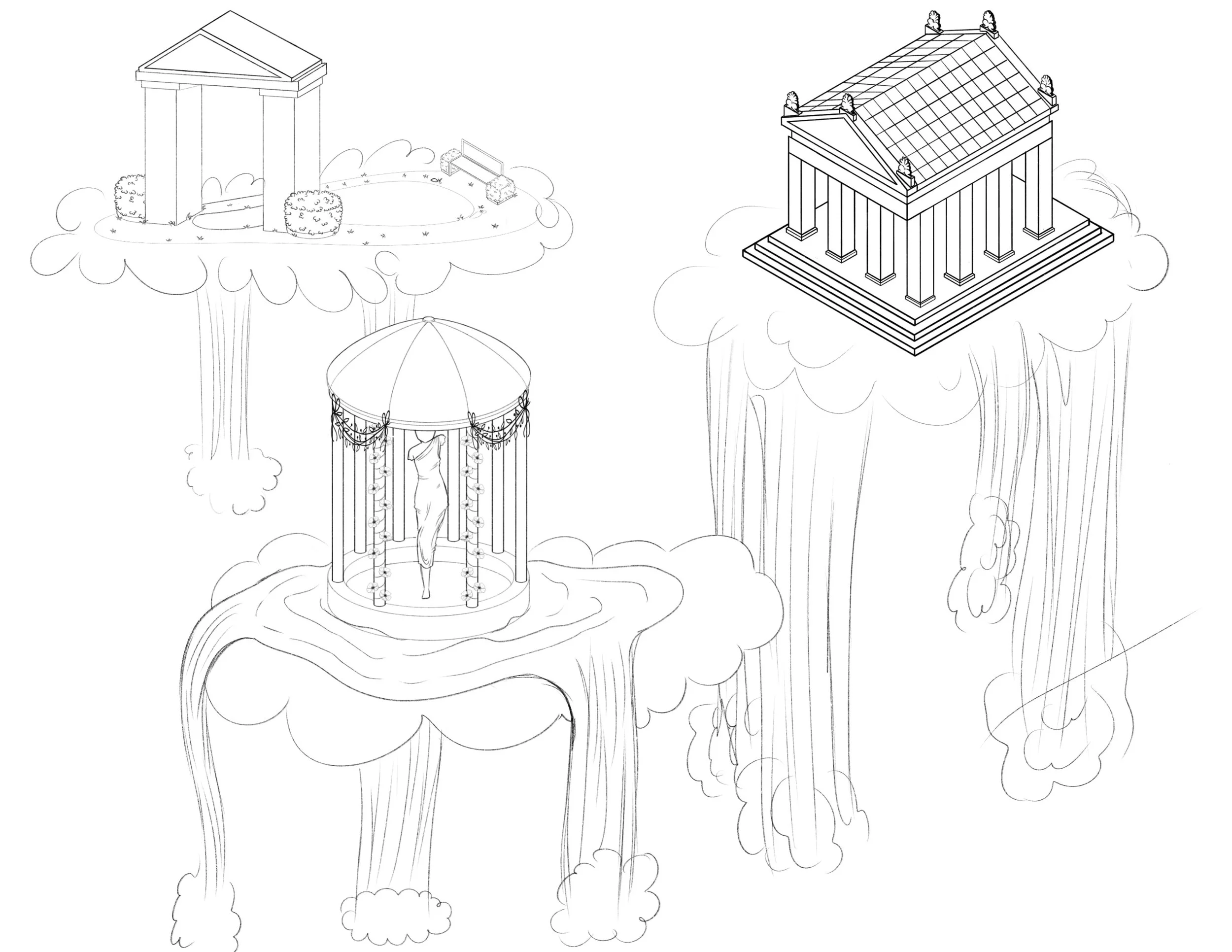
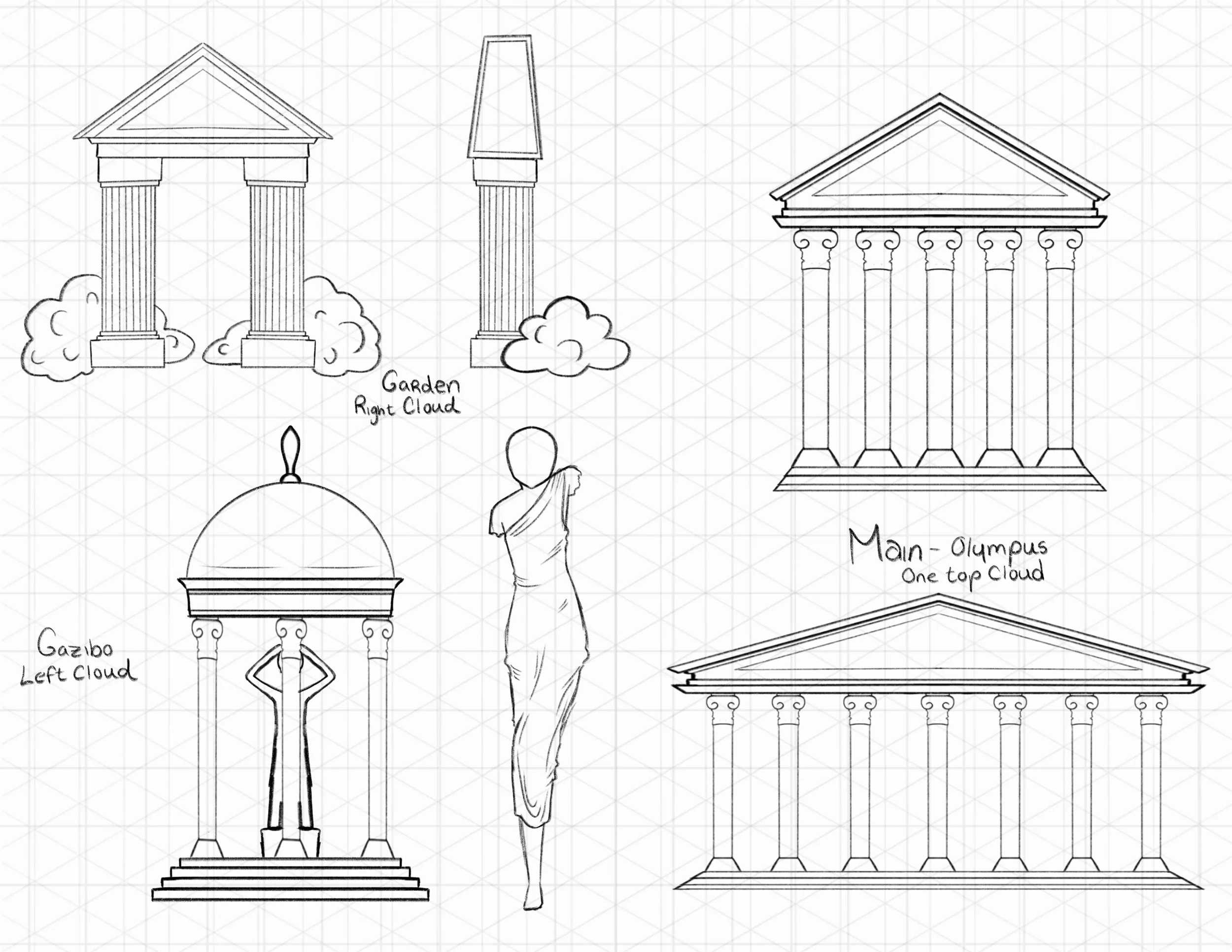
This project is a digital illustration exploring an isometric environment inspired by ancient Greek architecture and the mythology of Mount Olympus. The goal of the piece was to create a whimsical floating world composed of multiple temple structures, each placed on cloud islands, with waterfalls cascading into the sky below. The artwork began with detailed structural sketches, in which I designed the temples, columns, gazebos, and surrounding elements using isometric guidelines. These early drawings helped establish scale, architecture, and the overall composition. From there, I refined the layout by arranging the buildings across different cloud platforms, making sure each structure felt balanced and visually connected within the environment.
This illustration was inspired by classical architectural forms and Greek-inspired structures, reimagined within a whimsical fantasy setting. Each building references real-world architecture, but they were simplified and stylized to fit a playful, storybook aesthetic.
Instead of replicating exact historical accuracy, the focus was on capturing the essence of these structures: their symmetry, recognizable silhouettes, and iconic details. The floating islands and cascading waterfalls were added to shift the scene from realistic to imaginative, creating a world that feels atmospheric and removed from earthly constraints.
The clouds were intentionally exaggerated and rounded to contrast the rigid geometry of the buildings, creating a balance between structure and softness. Waterfalls were rendered with smooth, simplified shapes to maintain visual clarity and support the cohesive illustrative style. Colour choices were kept limited and harmonious to unify the composition and highlight the calm, surreal atmosphere.
Materials used:
Procreate
Adobe Illustrator
Learning Objectives & Skills Demonstrated:
☾ Understanding and Applying Isometric Perspective
☼ This project strengthened the ability to construct buildings using simplified isometric and geometric techniques, focusing on clarity, consistent angles, and three-dimensional form without relying on traditional vanishing points.
☾ Interpreting Real Architectural Forms into Stylized Illustrations
☼ Complex structures such as temples, pavilions, and monuments were translated into clean, simplified shapes while maintaining their recognizable architectural identity.
☾ Digital Illustration Workflow & Layered Construction
☼ The piece demonstrates efficient digital drawing processes, including layered sketching, vector-like line refinement, and controlled colour fills to maintain precision and stylization.
☾ Creating Visual Harmony Through Shape Language
☼ Rounded cloud forms were intentionally contrasted with rigid architectural structures to achieve rhythm, balance, and visual distinction.
☾ Colour Theory & Atmospheric Tone
☼ Limited palettes, soft gradients, and muted tones were used to build a cohesive mood, supporting the dreamy, surreal fantasy environment.
☾ Environmental Composition & Spatial Layout
☼ Floating islands, waterfalls, and cloud clusters were arranged to guide the viewer’s eye, maintain visual balance, and reinforce the vertical flow of the scene.
Challenges & Solutions
☾ Constructing Isometric Buildings With Consistent Angles
✶ Working in an isometric perspective can be tricky, since every structure must follow the same angle and depth without traditional vanishing points. Any slight angle shift makes the buildings look uneven or disconnected from the environment.
☼ To solve this, I established a consistent isometric grid and used it as a guide for all architectural forms. I checked each structure: columns, roofs, bases, and supports, against the grid to maintain uniformity. This ensured that every building matched the same viewpoint and felt cohesive within the scene.
☾ Balancing Stylization With Architectural Accuracy
✶ Simplifying real architectural references into clean, cartoon-style shapes risks losing essential form or readability. Too much realism breaks the aesthetic, but too much simplification can make structures unrecognizable.
☼ I focused on capturing the core silhouettes and essential features of each building while simplifying textures and details. By keeping the architecture readable but still stylized, the final result feels imaginative without losing its grounding in real forms.
☾ Creating Natural Flow in Stylized Waterfalls
✶ The waterfalls needed to look fluid and organic, but also match the clean, geometric aesthetic of the illustration. Poor flow can make them look stiff or disconnected from the islands.
☼ To solve this, I used smooth, controlled curves and repeated line patterns to create rhythm and movement. I layered soft highlights to give the water dimension while keeping the style simple and cohesive. The consistency of stroke direction helped unify the waterfalls with the architecture and clouds.
☾ Maintaining Depth Without Heavy Shadows
✶ Because the style is flat and minimal, heavy shading would break the aesthetic, but too little shading would make structures feel flat or floating without weight.
☼ I used subtle value shifts, gentle gradients, and selective shading on undersides and inner planes to create depth without overwhelming the softness of the illustration. This allowed the buildings to read clearly while preserving the clean, stylized look.